

What 2025 Changed About How Serious Teams Build AI
By Fyrasoft Technologies
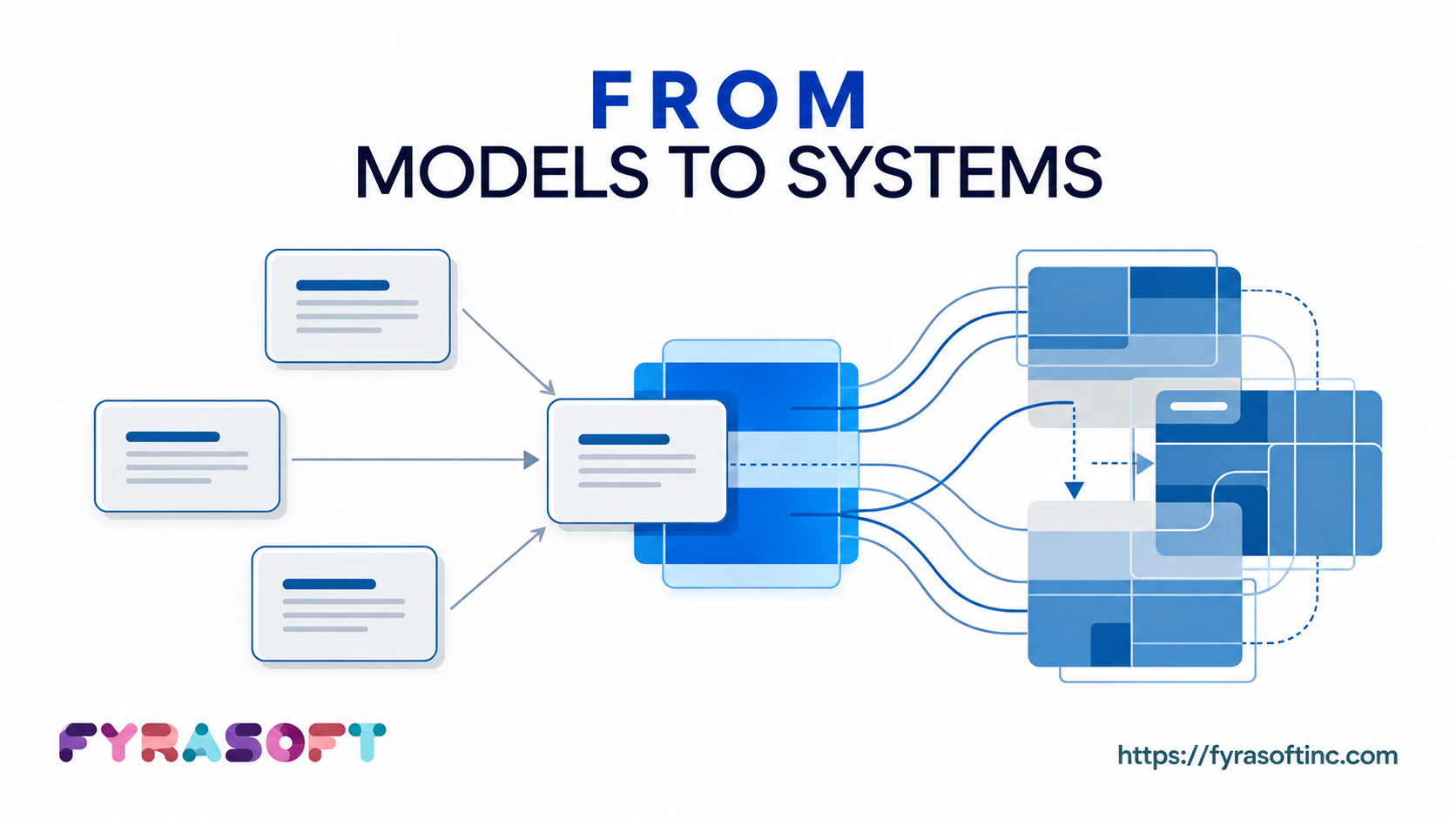
2025 was not the year AI became louder. It was the year it became structural.
If you strip away the noise, product launches, valuation headlines, speculative timelines, what actually changed was how teams talk about AI internally. The language shifted because the work shifted. AI stopped being something you add to a product and started becoming something you design around.
That change is subtle, but permanent.
Across engineering discussions, architecture reviews, and client conversations, the same themes kept resurfacing. Not as buzzwords, but as practical constraints and design decisions.
From Models to Systems
A year ago, most AI conversations centered on models. Which one to use, how large it was, how capable it sounded.
In 2025, that framing broke down.
Teams began talking about agents, retrieval layers, context orchestration, and reasoning depth. Not because it was fashionable, but because single-model intelligence kept hitting real-world limits. Models alone could not stay current, verify themselves, or safely operate inside business workflows without guardrails.
This shift is visible across the ecosystem, from infrastructure platforms to applied AI products, including how teams at OpenAI, Google DeepMind, and Microsoft increasingly frame AI less as standalone intelligence and more as system architecture.
As a result, architectures evolved.
AI systems today look less like chatbots and more like distributed software platforms. They have memory, permissions, validation steps, and failure handling. Intelligence became one component in a larger, deliberate design.
The Quiet War on Hallucinations
One of the most revealing shifts in 2025 was how little tolerance enterprises now have for almost correct AI.
Early excitement made hallucinations feel like an acceptable tradeoff. That window closed quickly. As AI moved closer to decision-making roles across operations, finance, compliance, and customer support, confidence without correctness stopped being impressive and started being dangerous.
This is why retrieval-augmented architectures, vector databases, and grounding mechanisms moved from research topics to default patterns. Not because they are elegant, but because they work.
Trust, it turns out, is an engineering problem before it is a policy one.
The move toward retrieval, grounding, and validation-first design mirrors patterns now seen in enterprise deployments discussed openly by teams at Amazon Web Services (AWS) and Google Cloud.
Efficiency Became a Design Principle
Another noticeable change is that teams stopped assuming infinite compute.
Between rising inference costs, latency expectations, and sustainability pressure, bigger quietly lost its appeal. Distilled models, mixture-of-experts architectures, and frugal AI practices gained traction. Not as compromises, but as marks of maturity.
In many production systems, the best AI was not the most powerful one. It was the one that could run reliably, affordably, and repeatedly at scale.
This shift separated experimentation from engineering.
Why Vibe Coding Exists, and Why It Is Not Enough
2025 popularized a new development style where engineers describe intent and let AI generate large portions of code. The productivity gains are real. So are the risks.
What became clear this year is that AI-assisted development does not remove the need for engineering discipline. It amplifies it. Testing, observability, security reviews, and architectural thinking matter more, not less, when code is generated faster than it can be understood line by line.
The teams that thrived were not the ones generating the most code. They were the ones who knew what to accept, what to reject, and what to rewrite.
The Content Flood and the Return of Signal
Outside engineering circles, 2025 also made something uncomfortable obvious. Not all AI output deserves attention.
Low-quality, mass-generated content flooded digital channels, reducing trust and discoverability across platforms. In response, quality, provenance, and intent quietly became differentiators again.
For businesses, this reinforced a hard truth. AI does not replace judgment. It scales whatever standards you already have.
Where This Leaves Serious Builders
By the end of 2025, a line had formed.
On one side were AI features. Impressive in demos, brittle in production. On the other were AI systems. Measured, governed, and integrated into real workflows.
The difference was not access to models. Everyone has that now. The difference was system thinking.
Understanding data flows. Designing failure modes. Managing cost curves. Embedding ethics into architecture instead of documentation. Treating AI as infrastructure, not magic.
Our View
We do not see AI as a shortcut. We see it as a responsibility.
The language that dominated 2025 reflects that shift. Away from novelty and toward accountability. Away from what can the model do and toward what happens when this runs every day, for real users, at scale.
That is where the next decade of AI will be decided.
This is the lens we apply at Fyrasoft Technologies Pvt Ltd when designing AI systems meant to run daily, at scale, and under real operational constraints.